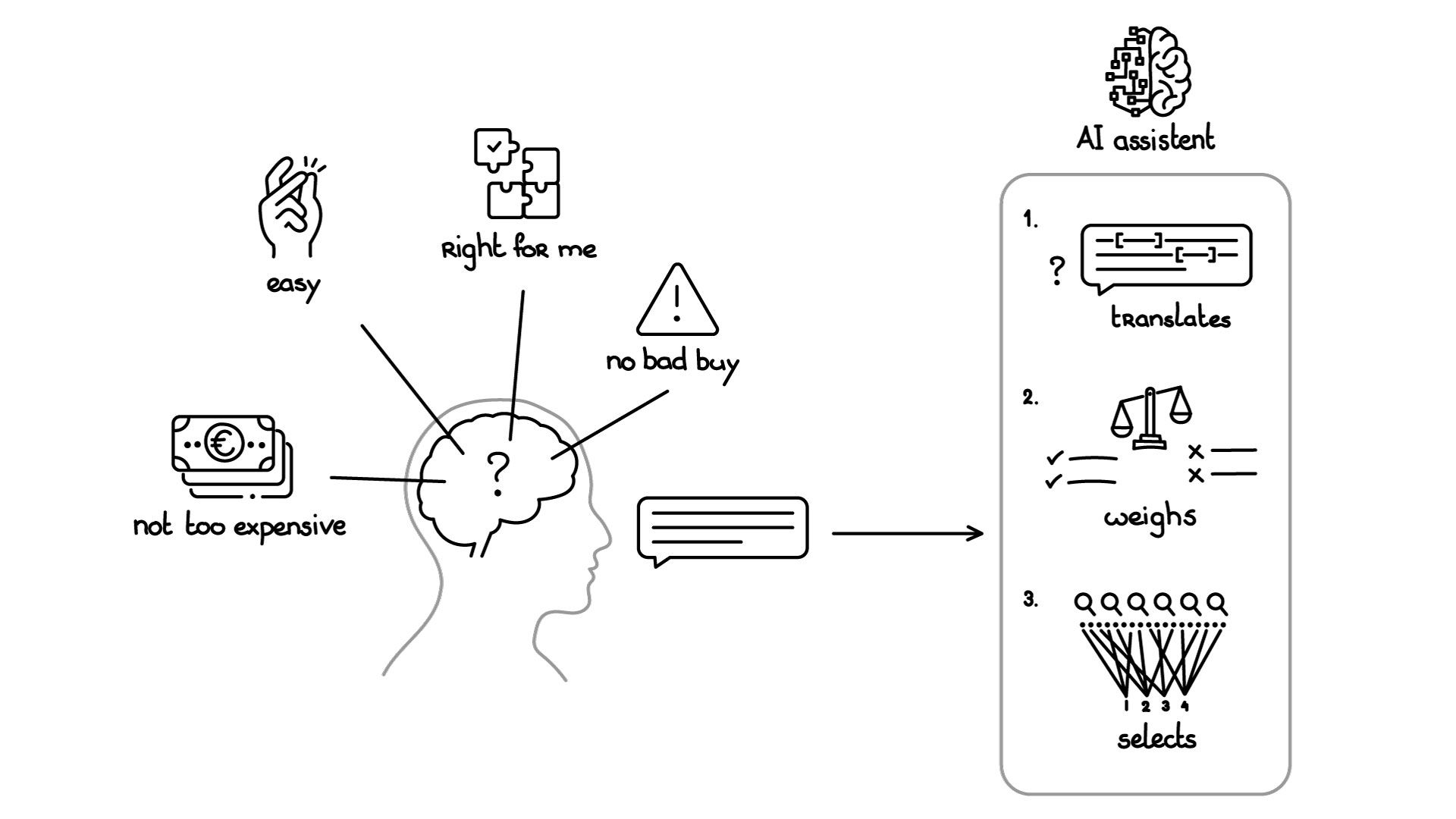
In brief:
- ChatGPT typically builds shortlists in layers: question, source, product, store.
- A follow-up prompt rarely reopens the full market. It usually reshuffles the existing shortlist.
- For online stores and brands, the first bottleneck shifts to the moment a product becomes source-worthy, comparable, and shortlist-ready.
The journey feels open to the buyer. In practice, it narrows at every step.
ChatGPT doesn't just help buyers choose. It builds the shortlist in layers. Across many buying questions, the same sequence tends to emerge: question, source, product, and only then store.
That matters, because it shows where the first cut actually happens. Not at the click. Much earlier.
In this article:
- how ChatGPT moves from buying question to shortlist
- why the source layer matters
- when price, store, and promotions enter the picture
It starts with a broad buying question, but not broad searching
Take a simple question: which bean-to-cup machine around €400 gives the best value, is reasonably quiet, has a good milk frother, and won't turn out to be a bad buy?
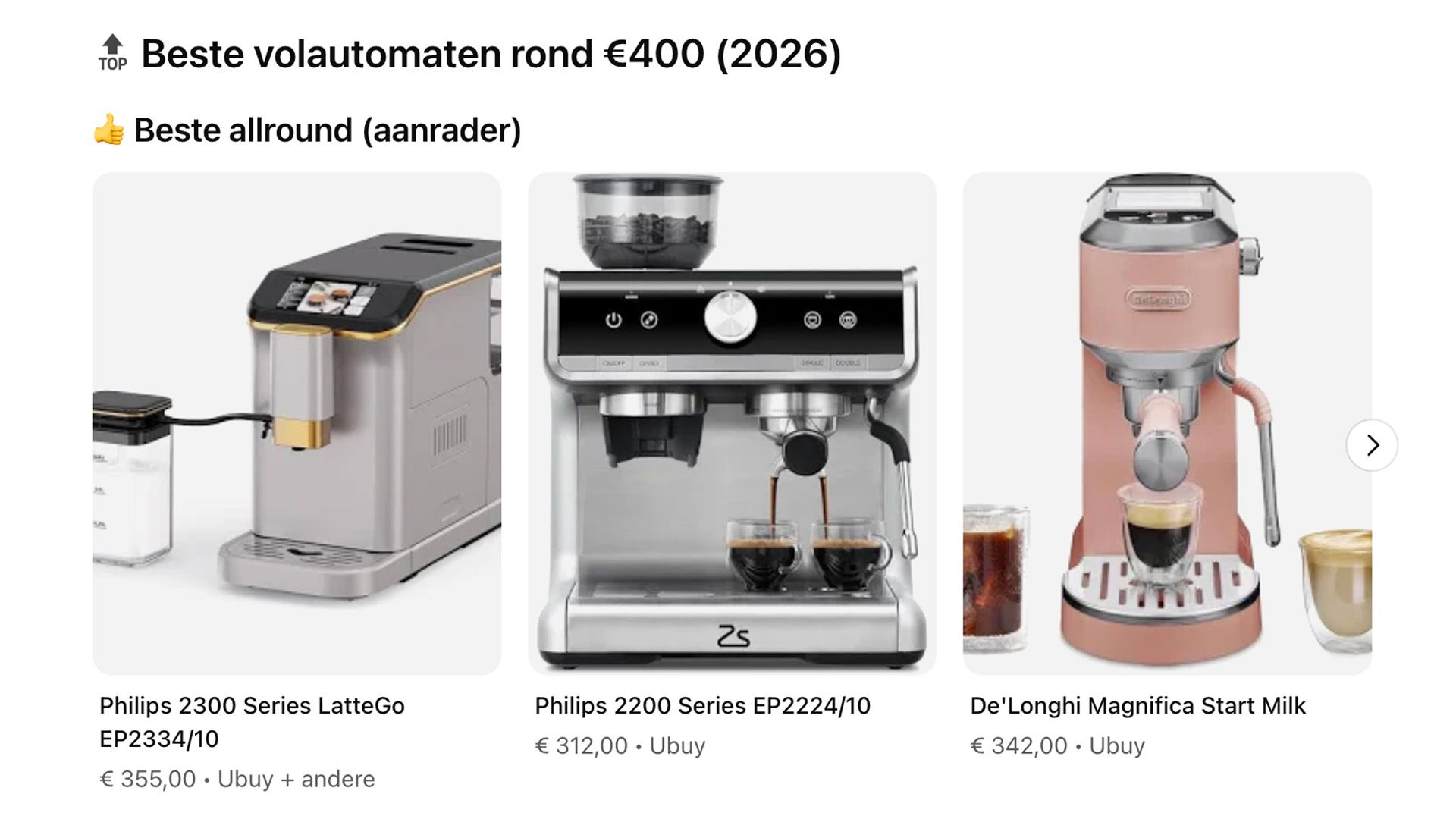
In the manual rerun we used for this article, that question produces a first shortlist immediately. Not a full market overview, a compact selection drawn from a small source layer of shortlist-style and review-style pages.
That's the first lesson.
For this type of buying question, ChatGPT typically doesn't start with full coverage. It starts with a workable first shortlist. Not twenty options and then help. Direction first.
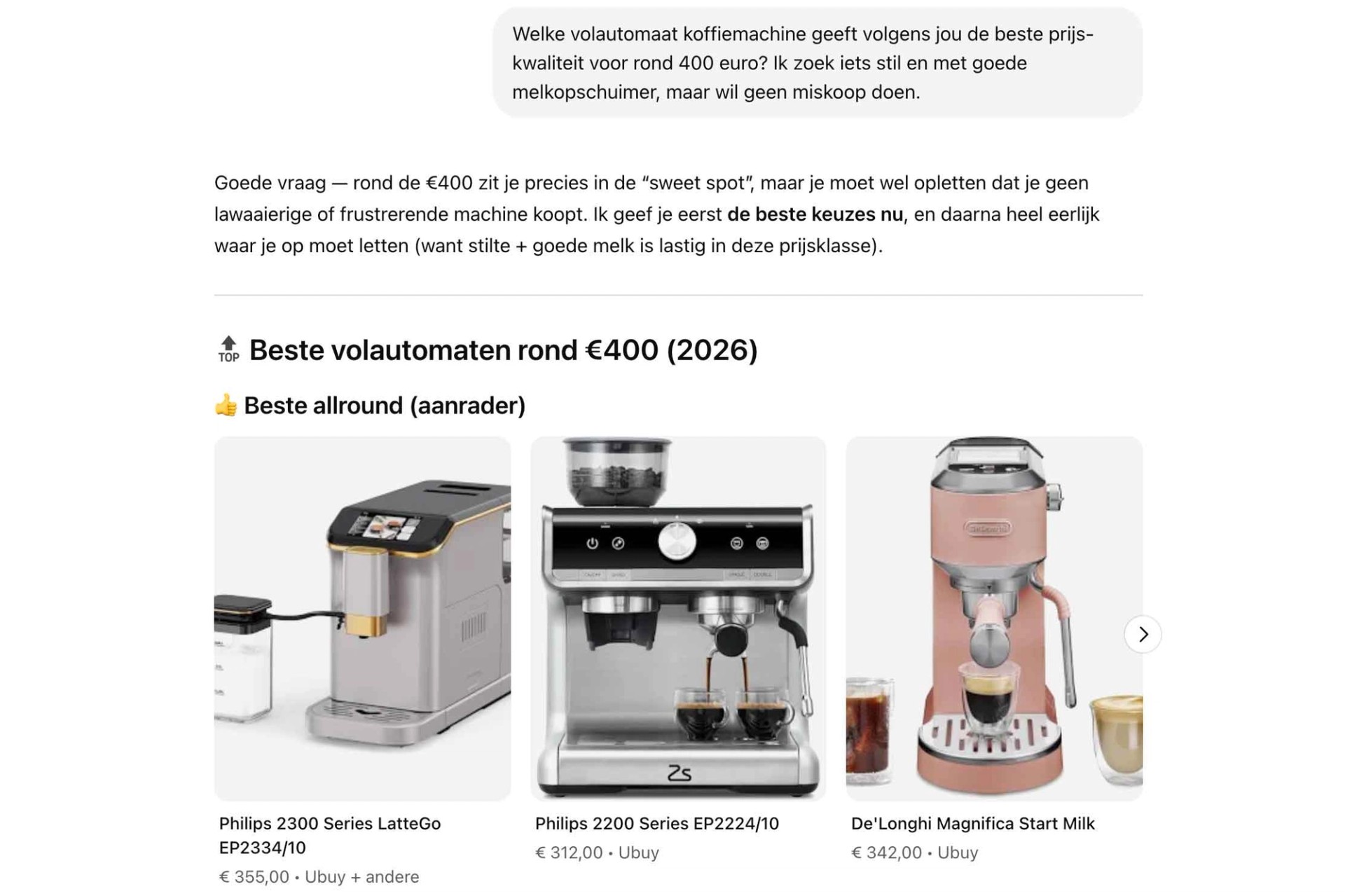
A broad buying question leads straight to a first shortlist of logical options.
One extra requirement shifts the source layer immediately
Then something interesting happens. The buyer doesn't ask about the whole category again, they zoom in on one attribute: noise. How loud is a specific model, and is that still acceptable in a small apartment?
The source layer shifts straight away. Where the first step was shortlist-style, now more specific review and test pages surface. The answer gets narrower, not broader.
That's the second lesson.
A follow-up prompt doesn't necessarily reopen the whole market. More often it pulls the source mix tighter around one model or one attribute. The question gets more specific, and so do the sources.
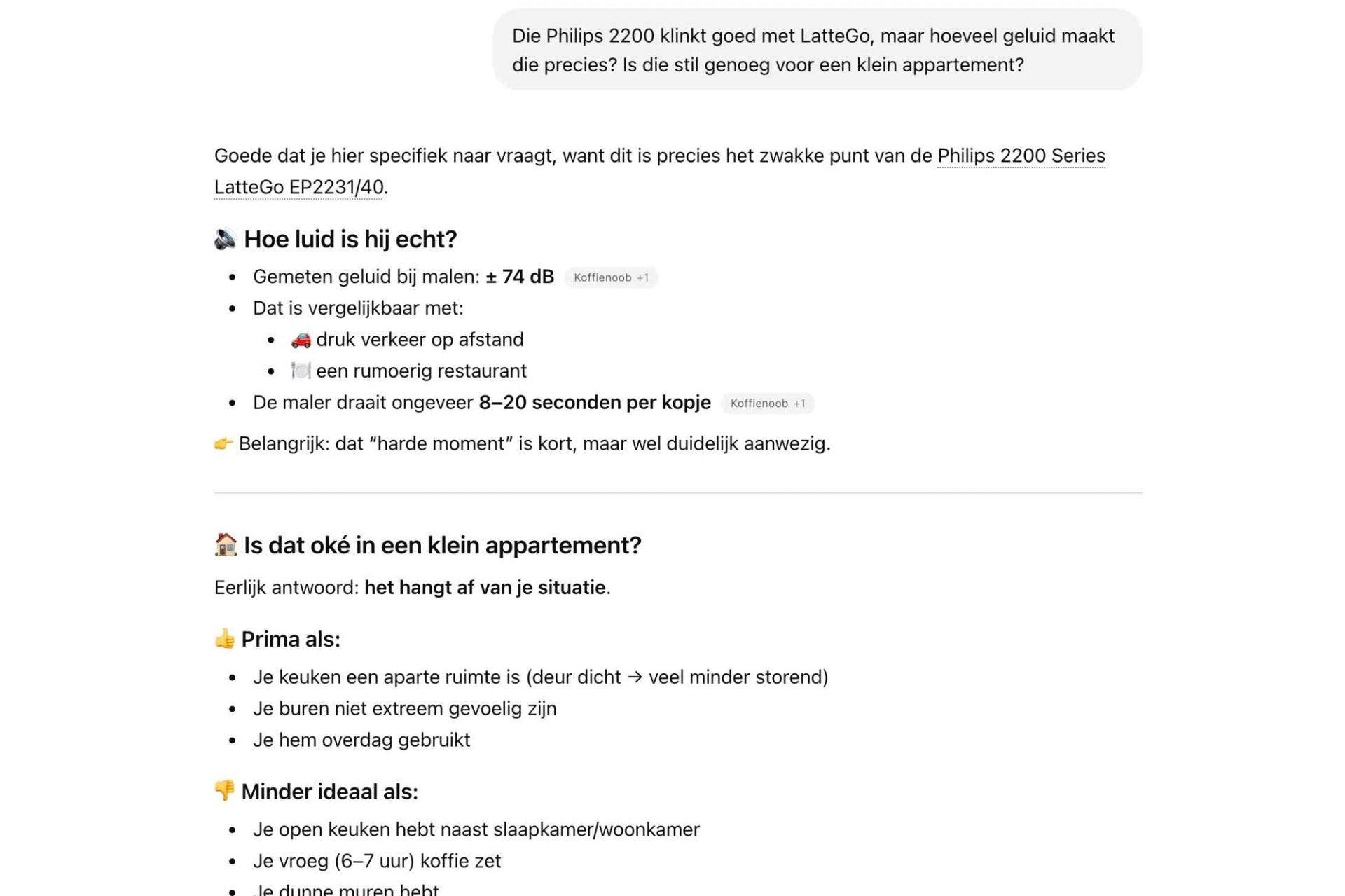
One extra requirement shifts the path straight from a broad shortlist to tests and reviews around a single model.
What's happening here
The buyer isn't asking for more options. They want more certainty about one relevant attribute. So the shortlist doesn't go wider, it goes deeper.
The shortlist shifts, but the market doesn't fully reopen
The buyer then says: suggest a quieter model within the same budget.
Again there's a search step, but the effect is different from the noise question. The conversation stays within the same product territory, but the shortlist moves. A quieter Philips 3300 surfaces as an upgrade. A De'Longhi Dinamica appears as an alternative when taste counts for more than silence.
That's the third lesson.
A follow-up prompt typically reshuffles the existing shortlist rather than reopening the full market. The answer feels flexible to the buyer. For the market, it's still a narrowing, just with different weights applied.
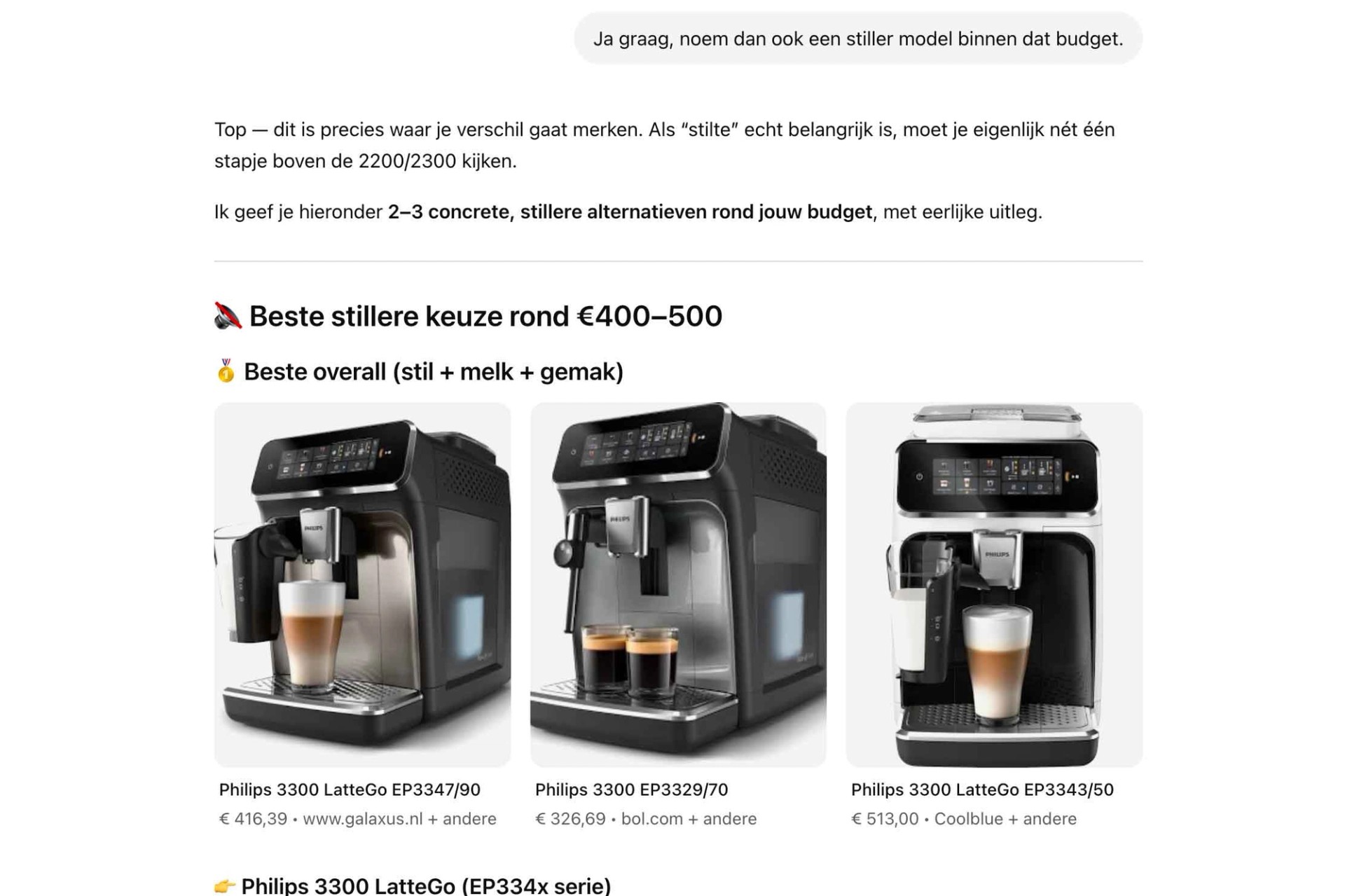
A follow-up prompt doesn't reopen the full market, it shifts the shortlist toward a smaller set of quieter alternatives.
The price layer comes later
When the buyer then asks which of those options is best priced in the Netherlands, the game changes again.
Price and deal sources enter the picture. The answer shifts from product suitability toward price ranges, deal timing, and store context. The product cards load differently too, no longer a broad shortlist, but Dutch variants with current pricing and a spread of retailers.
This step is worth watching carefully.
Many teams assume price and store carry equal weight from the start. In this sequence, they don't. First, ChatGPT determines which products still make sense. Only then does it look at where they're best available.
That's commercially important, because it shifts the first bottleneck. Not every store gets into the running from the first prompt. Not every product even qualifies for the price comparison.
Evidence from the conversation
1. broad buying question
2. first shortlist
3. attribute deep-dive
4. shortlist shifts
5. price and store context
6. compact final recommendation
Then comes a promotions layer
After price comes another layer that's practically important for e-commerce, but often looks messy: cashback, promotions, and limited-time deals.
Once that question appears, the source mix shifts again. Promotions pages, cashback overviews, and campaign pages start surfacing. For the buyer, it feels like a useful service. For the market, it's another filter, narrowing not just on product and price, but on current buying opportunity.
I wouldn't overestimate this layer. It rarely builds the shortlist. But once the shortlist and price layer are in place, it can push the decision a step further.
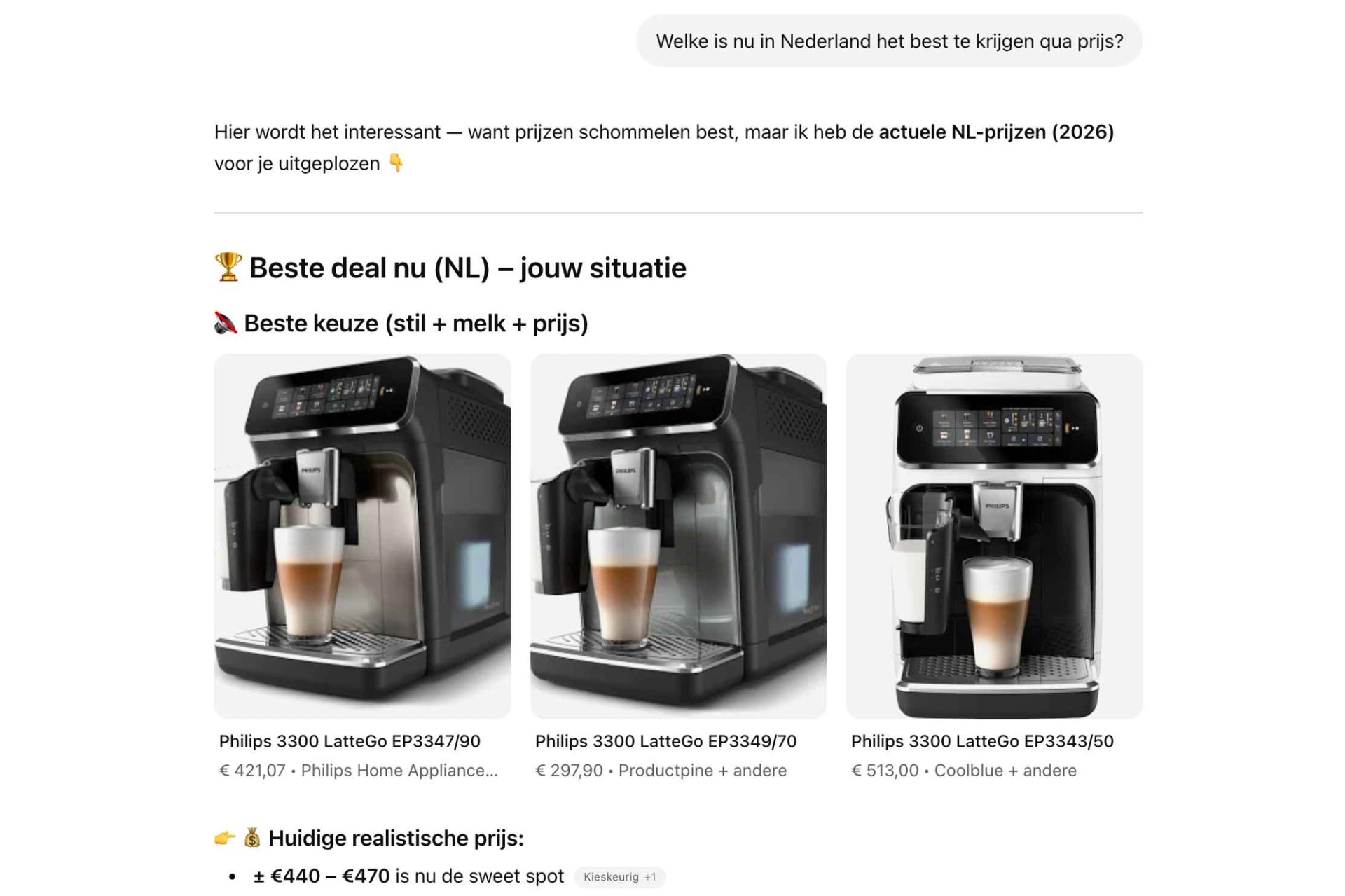
Only after the shortlist and refinement does the path shift toward current price, deal context, and store choice.
Everything compresses back to one recommendation
The last step in this conversation may be the most important. The buyer asks for a short summary: which one would you pick in my situation, and why?
What follows is exactly what you'd expect after a journey like this. The different layers fold back down into one compact answer. Multiple trade-offs resolve into a single clear recommendation, with two alternatives that remain logical but lose out on price or noise.
That's the fourth lesson.
The conversation gets richer as it progresses. The final answer gets smaller. The further the conversation goes, the more compressed the output tends to become.
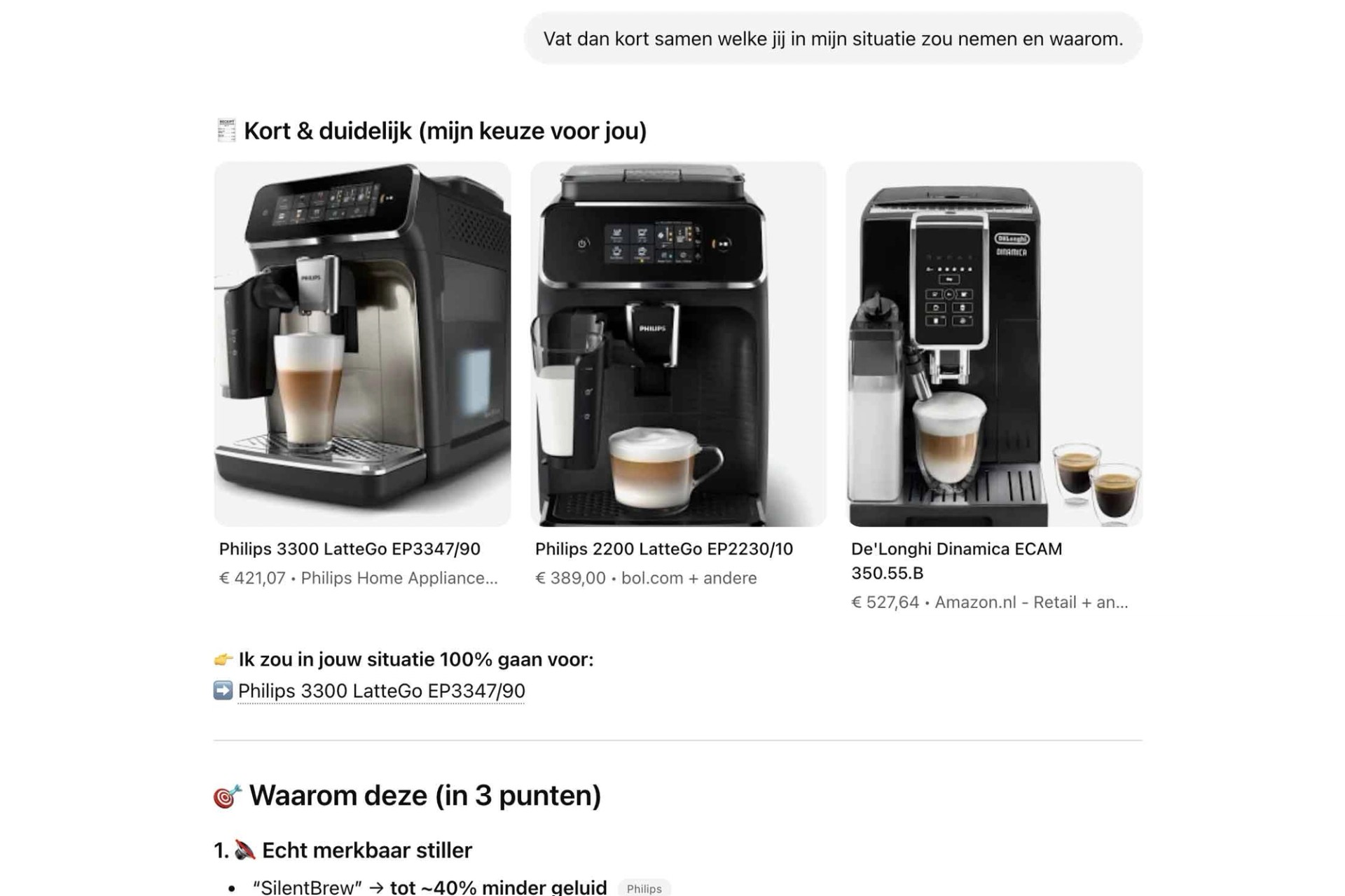
After shortlist, comparison, and price layer, ChatGPT compresses the whole journey back into one clear recommendation
What this means for online stores and brands
Translate this into e-commerce logic and you can see why shortlist survival is such a useful starting point.
ChatGPT shortlists don't form from a single perfect product page signal. They build from a chain:
- how a question is phrased
- which source layer fits it first
- which products then look like the logical options
- which follow-up questions shift the shortlist
- which stores remain in view after that
- and which promotion or reassurance provides the final push
That means you can't think only in terms of ranking or visibility. You need to think about fit for the conversation.
Four things that become immediately practical
1. Product name and model consistency
Once ChatGPT lands on a model, you don't want it to get blurry in the price layer or store context because of inconsistent naming.
2. Comparable specifications
Not just on the product page, also on pages that can resurface as sources later in the conversation. Think noise levels, maintenance, milk systems, size, ease of use, and whether the thing is going to be a pain to live with.
3. Explicit use cases
'Good product' is too vague. 'Reasonably quiet in a small apartment' or 'easy to clean if you make cappuccino every day' is far more useful in an AI buying conversation.
4. Price and deal hygiene
Once the shortlist is in place, attention shifts quickly to current price, store, and promotions. That's not a moment to fall out of view.
The simple version
ChatGPT typically builds that narrowing in layers. First source, then product, then price, store, and promotions.
That's exactly why this sequence matters for GEO. Not because it's mysterious, but because it's surprisingly easy to follow once you look at enough buying conversations side by side.
And that's when you can see where a store or brand needs to win first.
Not at checkout. Not even at the product page. But at the moment a question becomes source-worthy, comparable, and shortlist-ready.
Also read:
AI & CommerceFrom Shortlist to Click: How Price, Store, and Reassurance Decide the Winner
After the shortlist, the best product doesn't automatically win. In AI buying journeys, price, store, and reassurance decide who gets the click.
Read more →