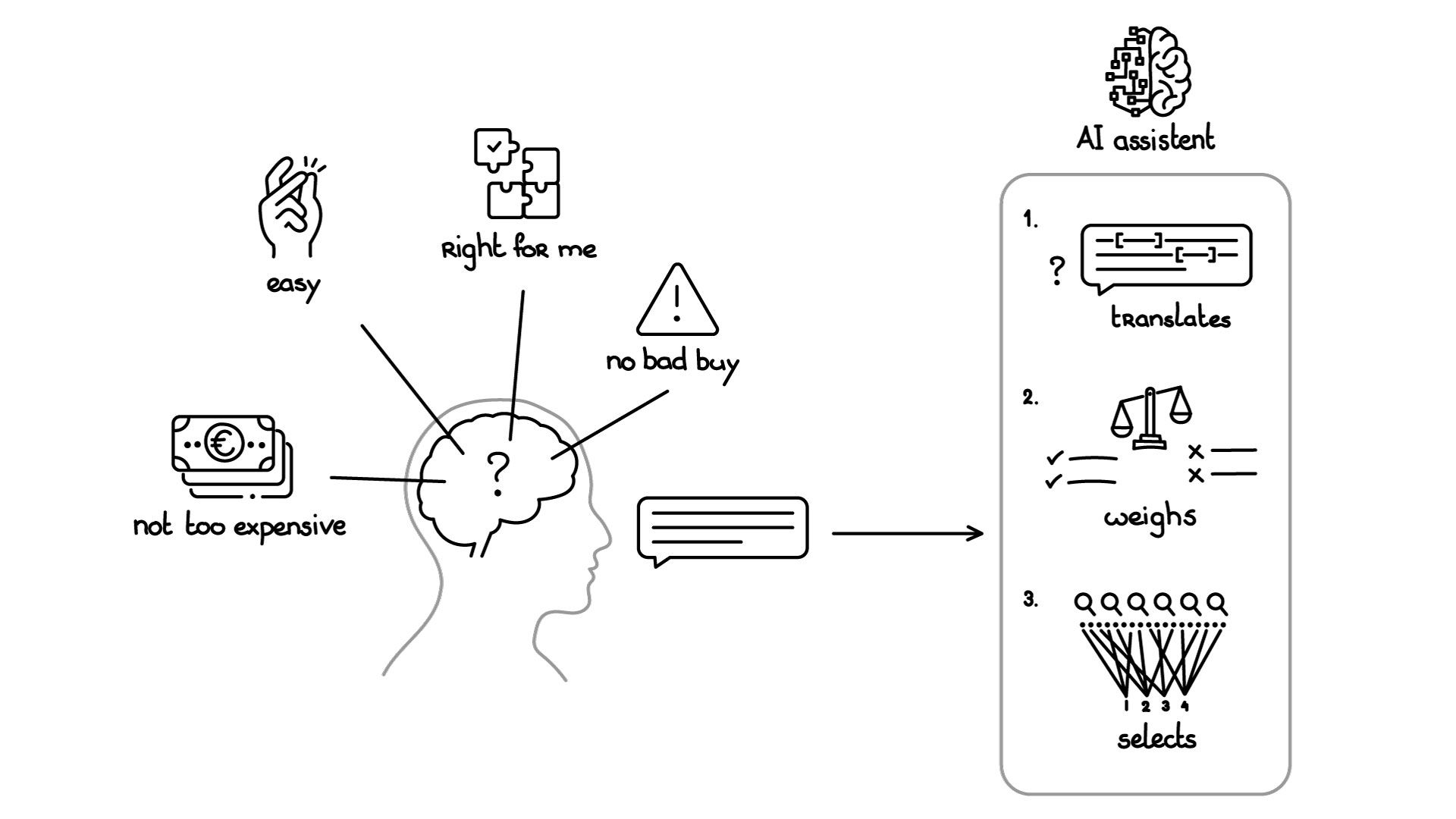
In brief:
- The shortlist isn't the finish line, it's where the real commercial competition begins.
- After the shortlist, the path typically shifts toward price, store, promotions, and reassurance.
- The cheapest option doesn't automatically win, the one that best fits the buyer's situation does.
The first article showed how ChatGPT narrows the field early. The second showed how that shortlist is built: from question to source, from source to product, and only then to store. The logical next question is no longer how the shortlist forms, it's what happens after it. Because that's where the real commercial competition starts.
Many teams still assume the winner simply rises to the top from there. Best product, lowest price, done. But that's not how AI buying journeys typically work. Once ChatGPT has reduced the market to a few logical options, the path shifts: store choice, current price, promotions, and reassurance.
It sounds like the last stretch of the funnel. In practice, it's the phase where a shortlist turns into a click.
The shortlist decides who stays in the running. After that, price, store, and reassurance decide who gets the click.
The shortlist is not the finish line
The rerun from the second article shows this quite literally. The buyer starts broad, gets a first shortlist, zooms in on noise, asks for quieter alternatives within budget, then moves to pricing in the Netherlands, checks cashback, and ends by asking which machine is the best choice for their situation. That's not a straight line to checkout, it's a conversation that keeps narrowing, and the answer gets more commercial as it goes.
That matters.
The shortlist determines who stays in the running. After that, the question becomes: who feels safe, logical, and current enough to earn the click?
Shortlist survival is still the first gate. It's just not the last one.
Evidence from the rerun
- broad buying question
- first shortlist
- noise as a risk question
- quieter alternative within budget
- pricing in the Netherlands
- cashback or promotion
- compact final recommendation
Store choice is not neutral
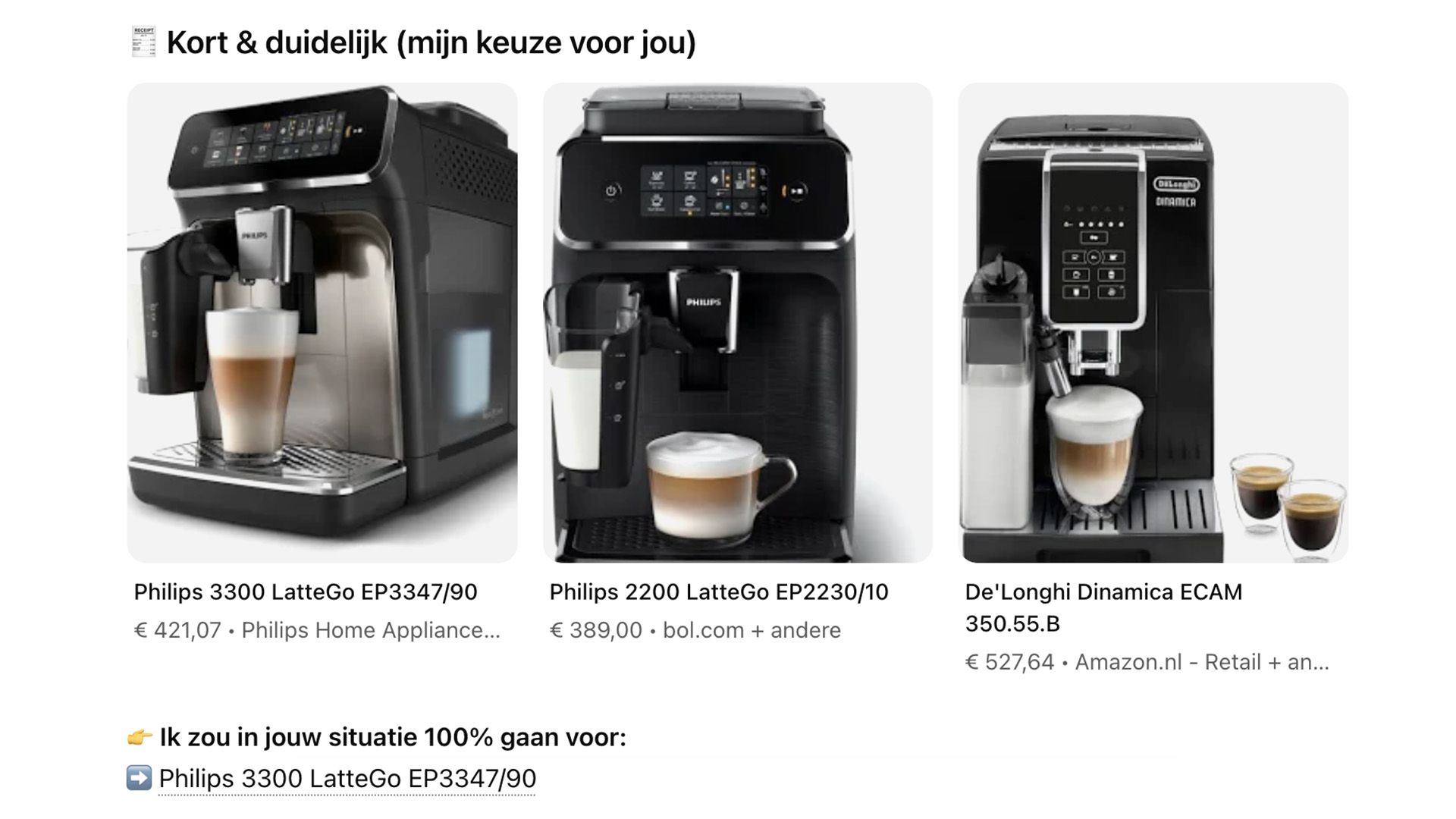
In the price step of the rerun, the source layer shifts again. The moment the buyer asks which option is best priced in the Netherlands, sources like Kieskeurig, BCC, Supersales, and EP come forward. The answer shifts with them: no longer a broad product overview, but current price ranges, store context, and practical buying advice.
That reveals something many online stores underestimate.
Not every store is part of the conversation from the first shortlist. A product can be shortlist-worthy without your store appearing prominently in the price layer. The reverse is also true: a retailer can appear strongly later, because price, availability, or promotions fit the buyer's situation better at that moment.
Store choice doesn't become relevant after the click. It gets built into the answer.
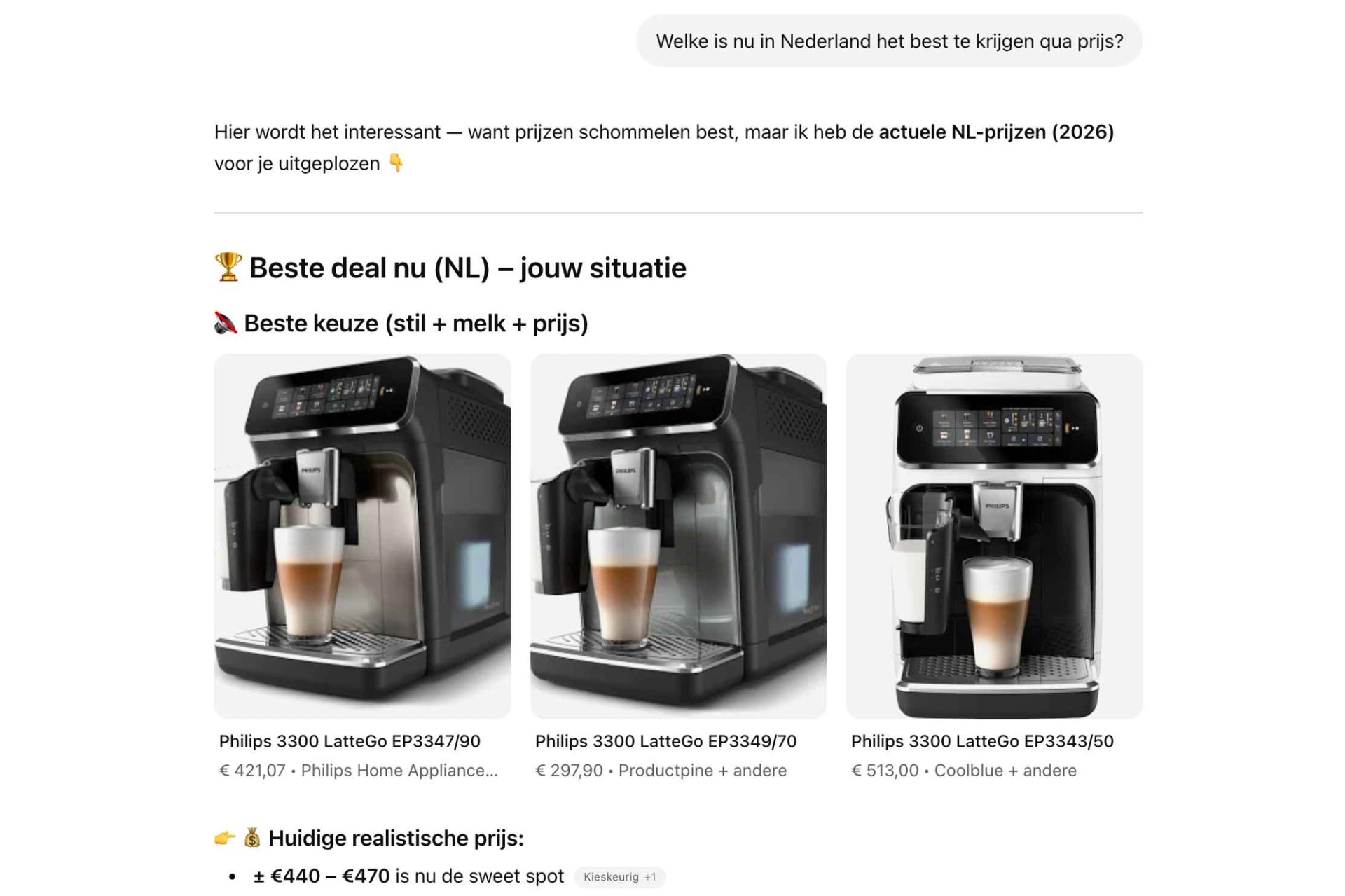
Once the shortlist is in place, the conversation shifts to current price, store choice, and buying context.
That's exactly why price data, stock levels, model consistency, and retailer context are no longer just operational details. They become part of visibility.
The cheapest option doesn't automatically win
Another common assumption: that ChatGPT simply picks the lowest price after the shortlist and moves on.
That's not what the rerun shows.
When the buyer asks about price, ChatGPT doesn't just flag what's cheap, it identifies what's the best deal 'for your situation.' It lays out a price range, a sweet spot, a buying recommendation, and even an implicit timing signal: under a certain price, buy now; above it, wait. The answer doesn't behave like a bare price comparison. It behaves like a buying guide with commercial preferences built in.
That's a meaningful difference.
The final winner isn't automatically the cheapest option, it's the one that forms the best combination, within the context of the conversation, of:
- fit
- price
- convenience
- trust
- timing
In this session, the Philips 3300 holds up as the logical choice despite cheaper alternatives. Not because it has the lowest price everywhere, but because quiet in a small apartment weighs heavier than purchase price alone. That's not classic price logic. That's context-driven buying logic.
The final winner isn't automatically the cheapest option, it's the one that forms the best combination of fit, price, convenience, trust, and timing within the context of the conversation.
Reassurance becomes a conversion layer
This makes the post-shortlist phase commercially interesting in its own right.
After the first cut, buyers rarely just want a price. A risk question almost always follows. In this rerun it was about noise and apartment suitability. In other categories it might just as easily be about returns, durability, size, maintenance, compatibility, or simply: am I going to regret this? The form varies. The function is the same: remove doubt before the click.
That's why reviews, test pages, how-to content, and retailer trust matter so much in this phase. Not because they always build the first shortlist, but because they help a product survive it.
You see that clearly at the end of the conversation too. The buyer asks for a short summary: which one would you pick in my situation, and why? ChatGPT compresses everything back into one clear recommendation, with two alternatives that remain logical but lose out on noise or price. The conversation gets richer as it progresses. The final answer gets smaller.
That's not a detail. That's exactly where the click either happens or doesn't.
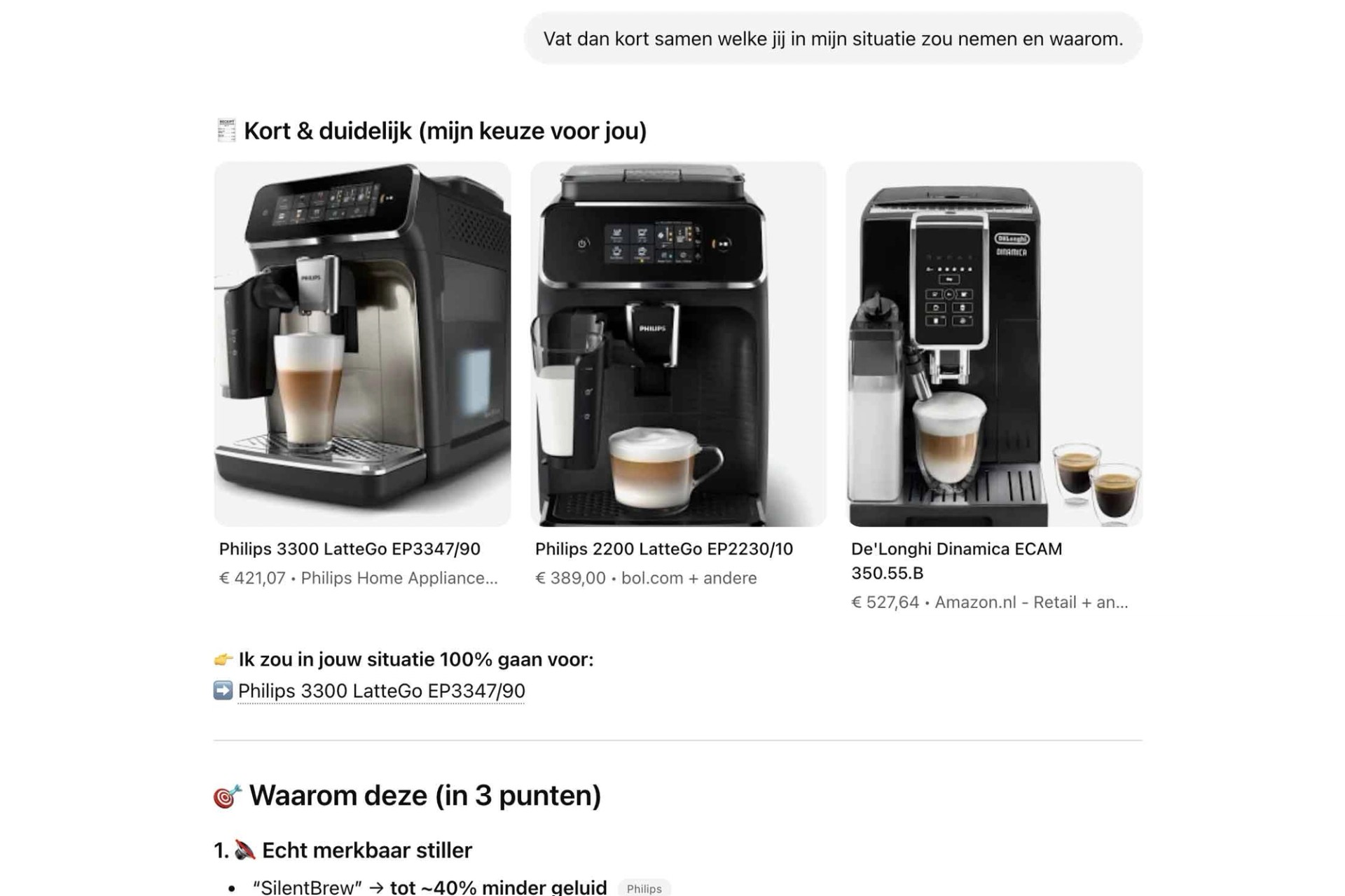
After shortlist, price, and reassurance, ChatGPT compresses the whole path back into one concrete recommendation.
Sometimes an extra promotions layer follows
After shortlist and price, a further commercial layer can appear: cashback, promotions, and limited-time deals. In the rerun we ran for this article, that question opened a different source mix, including cashback overviews, store promotions, and campaign PDFs from the likes of Coolblue, Cashbackvergelijken, EP, and Philips.
It doesn't always produce the cleanest answer, but it reveals something useful: once the shortlist and price layer are in place, ChatGPT can layer in promotions and deals that push the decision further.
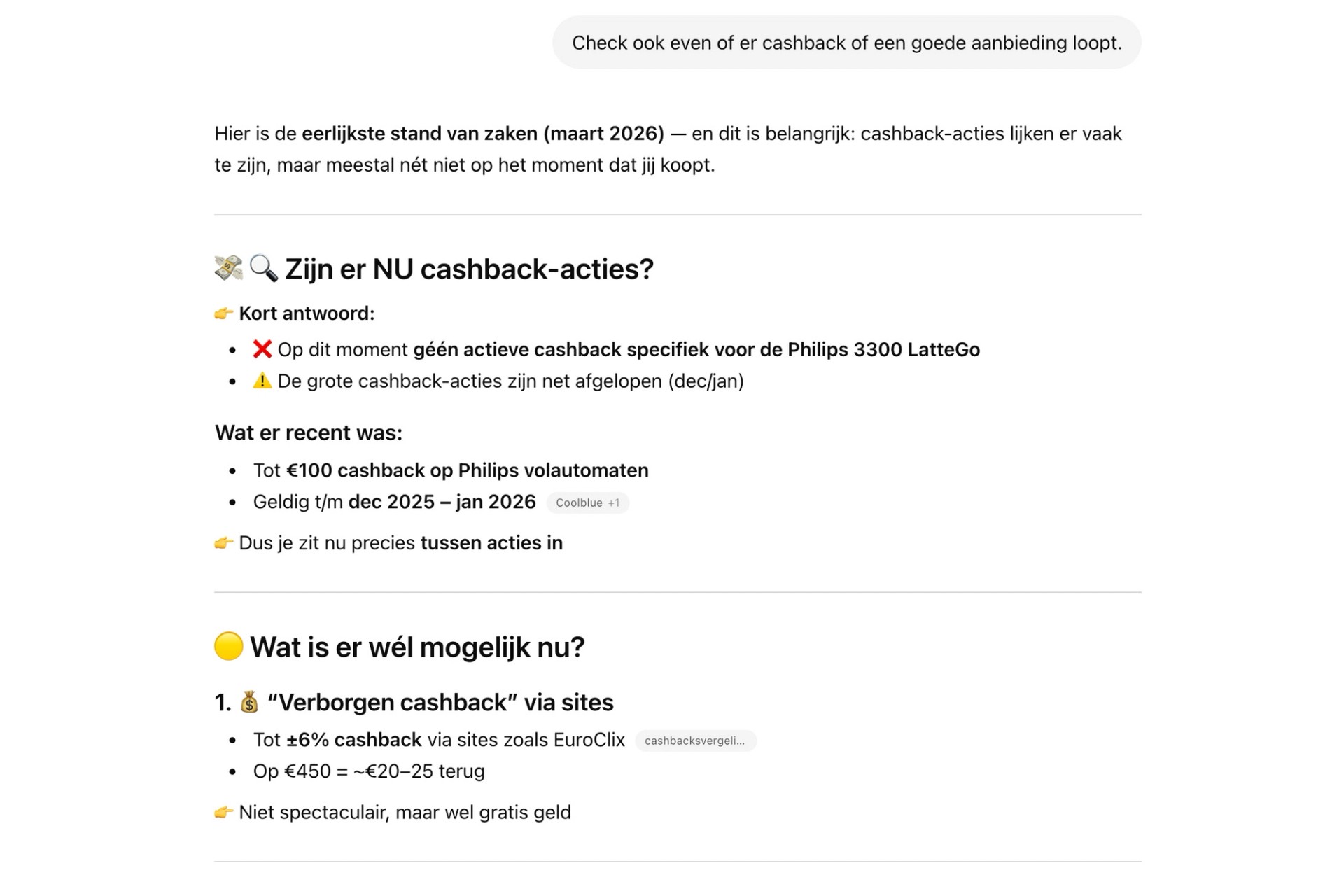
After shortlist and price, a promotions layer can follow, cashback, limited-time deals, or retailer offers.
For the buyer, it feels like useful service. For the market, it's another filter. Not everything that made the shortlist stays equally attractive once promotions enter the picture.
What this changes in practice for online stores and brands
Translate this into e-commerce terms and the main takeaway from this third article is fairly simple:
After the shortlist, the product that wins isn't automatically the best, it's the best answer to the buyer's specific situation.
That has a few practical implications.
Strategic implications
1. Product name and model consistency has to be right
Once ChatGPT settles on a model, you don't want it to get blurry in the price layer or store context because of messy naming, inconsistent titles, or slightly different model codes. That kind of clutter costs visibility exactly when the path is narrowing.
2. Price, availability, and promotion hygiene become visibility signals
Price isn't just a final loose step here. Once the shortlist is in place, current store context becomes part of the answer. That means price, stock, store information, and promotions aren't just operationally relevant, they literally determine whether you stay in view.
3. Risk questions need strong answers somewhere
Many buying conversations tip on reassurance, not price. Not "what does it cost?" but "is it quiet enough?", "how much hassle is it?", "can I return it easily?" or "will I regret this in two months?" If your brand or products don't have strong, findable answers to those questions, you'll keep showing up as a logical option that never gets the click.
4. Retailers are not neutral pass-throughs
In an AI buying journey, a store doesn't just get traffic because it happens to have stock. A retailer can win because the shop feels safer, clearer, cheaper, or more credible at the right moment. Return policy, service expectations, review volume, and promotions all factor into the same answer.
5. Promotions need to be current
Once shortlist and price layer are in place, cashback, limited-time discounts, and retailer promotions can still decide who gets the click. Keep that layer current, visible, and consistent.
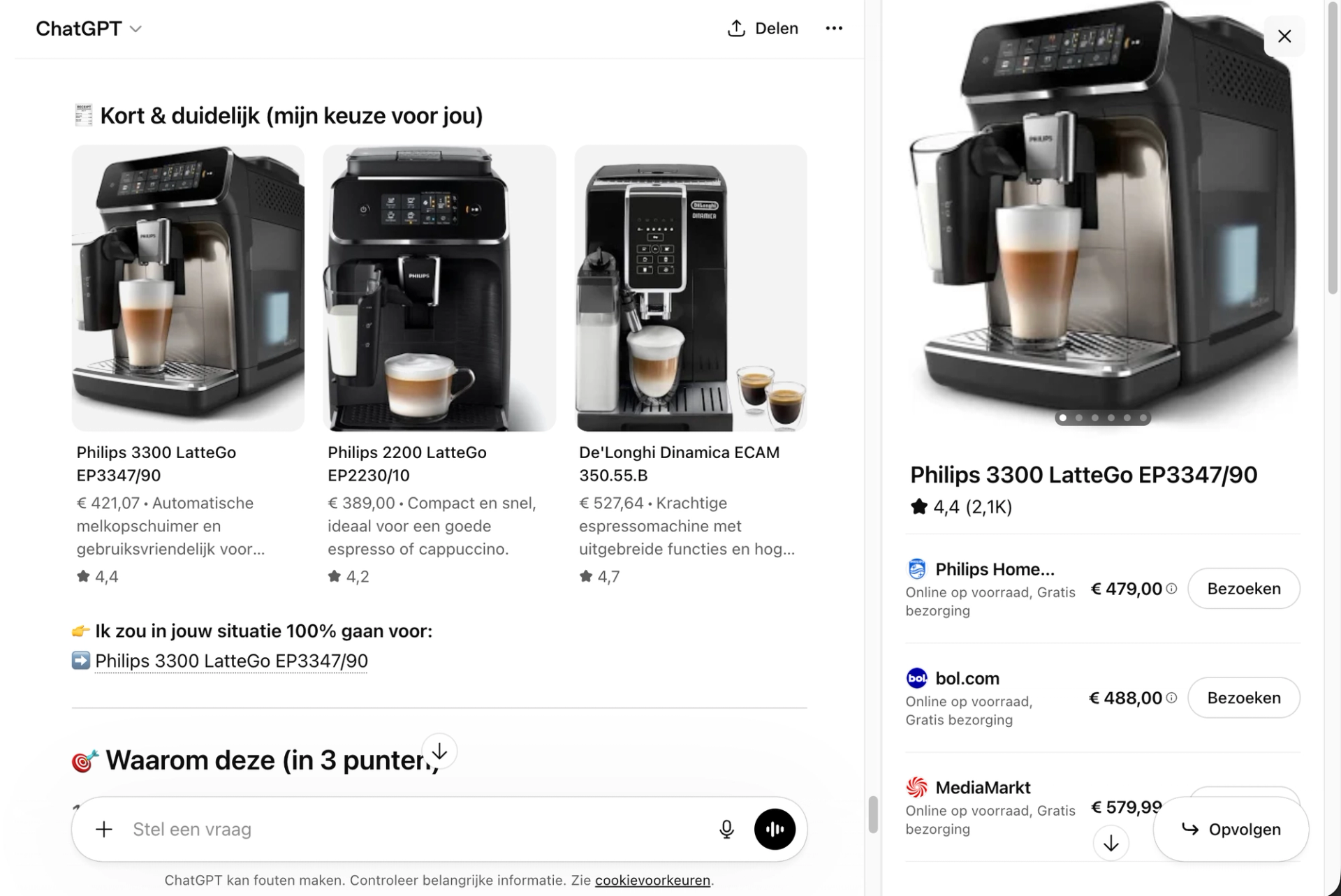
Purchase options are shown in side bar or mobile popup once a product name has been clicked.
What you can do tomorrow
- Audit product names, model codes, and variant names across all key sales and review pages
- Make price, stock, and promotion data consistent and current
- Identify which risk questions buyers still have just before the click
- Identify which retailers in your category feel safe, logical, and credible enough
- Test where your products drop out of view after the shortlist
The new question after the shortlist
The first question in GEO for e-commerce was: do we make the shortlist?
The next question is sharper:
Are we still the logical click once price, store, and reassurance start to count?
That's the real shift.
It's not enough just to be shortlist-worthy. You also need to be:
- easy to compare
- well priced
- readily available
- good at removing doubt
Only then does visibility turn into preference.
The shortlist decides who stays in the running. After that, price, store, and reassurance decide who gets the click.
Want to know where your range drops out after the shortlist?
Brazen helps brands and online stores map:
- which products keep coming back
- which sources and comparisons shape the path
- and where price, store, and reassurance determine the click
Also read:
AI & CommerceDoes Your Product Make the ChatGPT Shortlist?
ChatGPT narrows choice in e-commerce. The question is not just whether you're visible, but whether you survive the first shortlist.
Read more →AI & CommerceHow ChatGPT Builds Shortlists
ChatGPT builds shortlists in layers: question, source, product, store. This is how that selection takes shape in e-commerce buying journeys.
Read more →