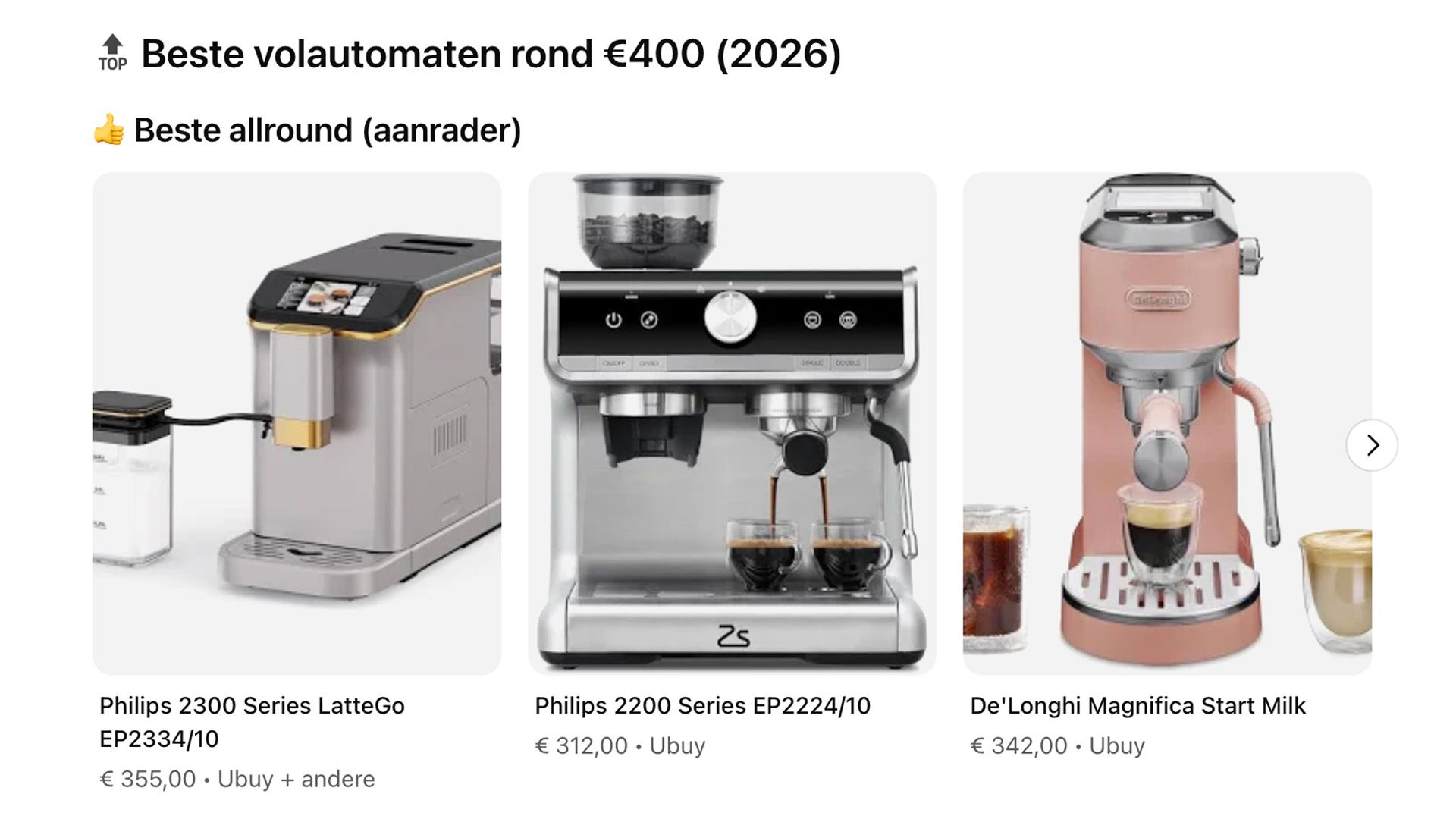
Online retail was built on choice. Wide category pages, filters, brands, variants, comparison sites and marketplaces. For years that made sense. The bigger the range, the better the chance that the right product was somewhere in it.
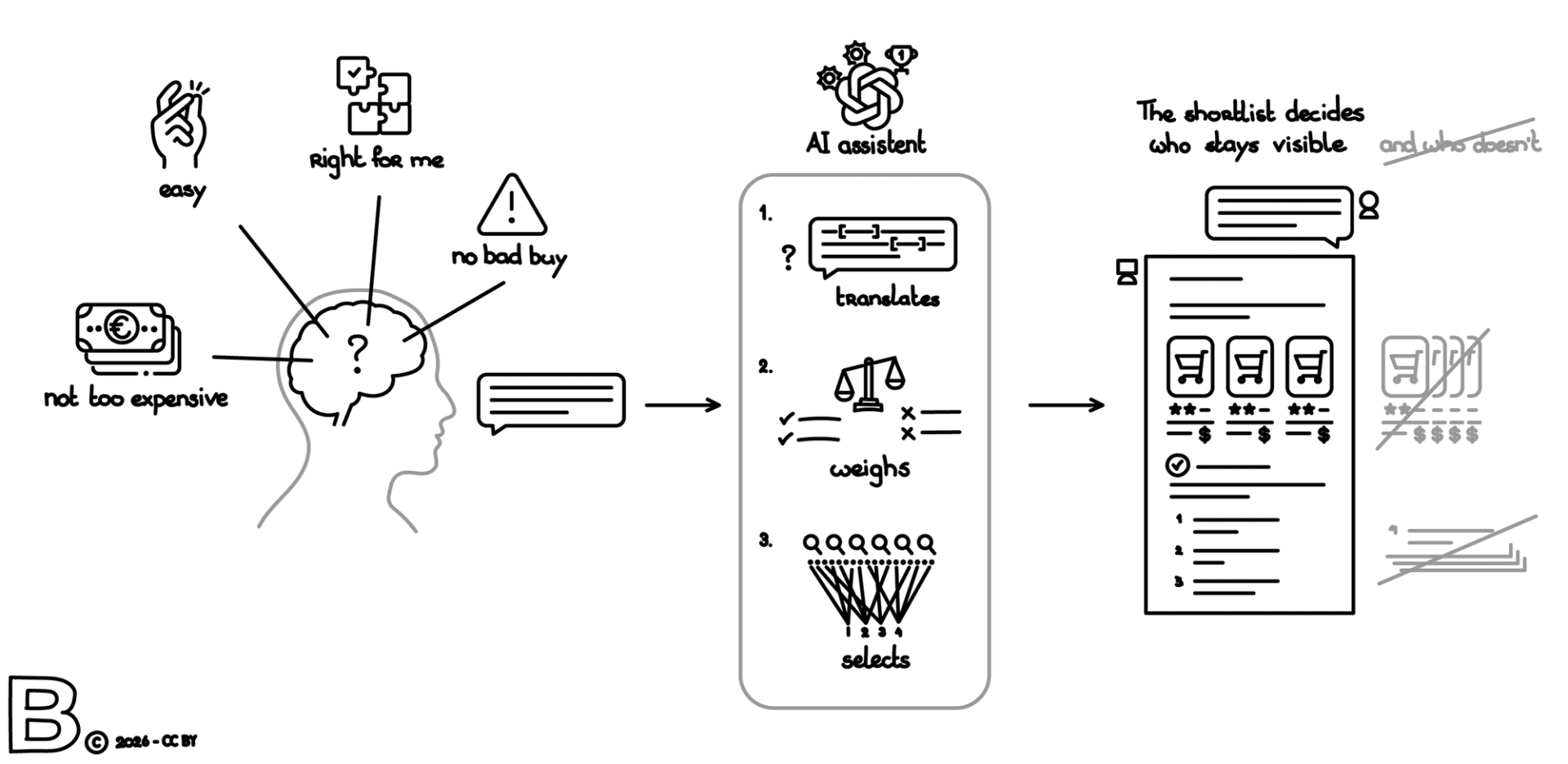
The AI assistant translates, compares and selects, creating a shortlist while pushing other options out of view.
In this article:
- why ChatGPT narrows buying questions early
- why that matters commercially
- where to look first
ChatGPT works differently. Not less supply in the market, but less in view. When buyers don't know what they want yet, the journey starts with a cut, not a full category.
Most e-commerce teams are still underestimating this. AI assistants aren't just another channel. They decide, earlier in the process, which products, brands and retailers are still in the running.
Being visible is no longer enough. The question is whether your products make that first cut.
For the shopper it feels open. For the market it is already selection.
Why buyers start here
People don't open ChatGPT because they've forgotten how to search. They open it because they don't know what to filter for yet.
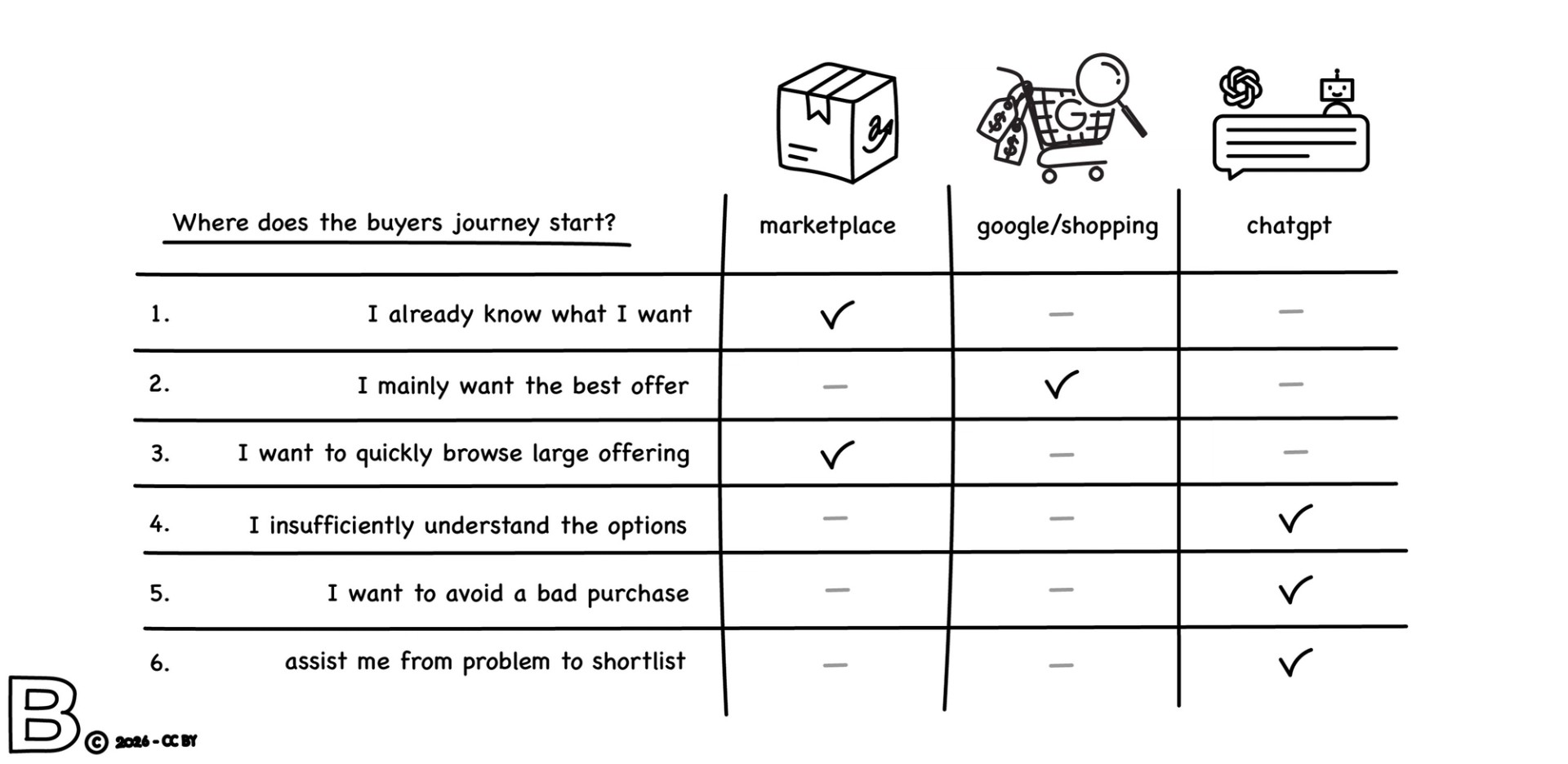
Not every buying journey starts in the same place. ChatGPT becomes attractive when the buyer does not yet have the right language for filtering.
ChatGPT is most useful when the buyer doesn't have a product in mind, only a problem.
They're not looking for a model number. They want something that works. Something easy to clean. Something quiet. Something that feels solid, isn't too expensive, and won't turn out to be a mistake. Filters can't help with that. You need to already know how to describe what you want.
That's where an assistant earns its keep. Not because it shows everything, but because it turns a vague question into a shortlist.
A webshop shows you a category and helps you choose. ChatGPT narrows first, then sends you to a store.
The shortlist appears earlier than most teams think
That pattern shows up even in the simplest questions.
A user asks for a bean-to-cup machine that's easy to use, easy to clean and not too expensive. That's not a sharp product query. It contains budget, convenience, maintenance and the fear of a bad buy, but no model, brand or clear set of filters.
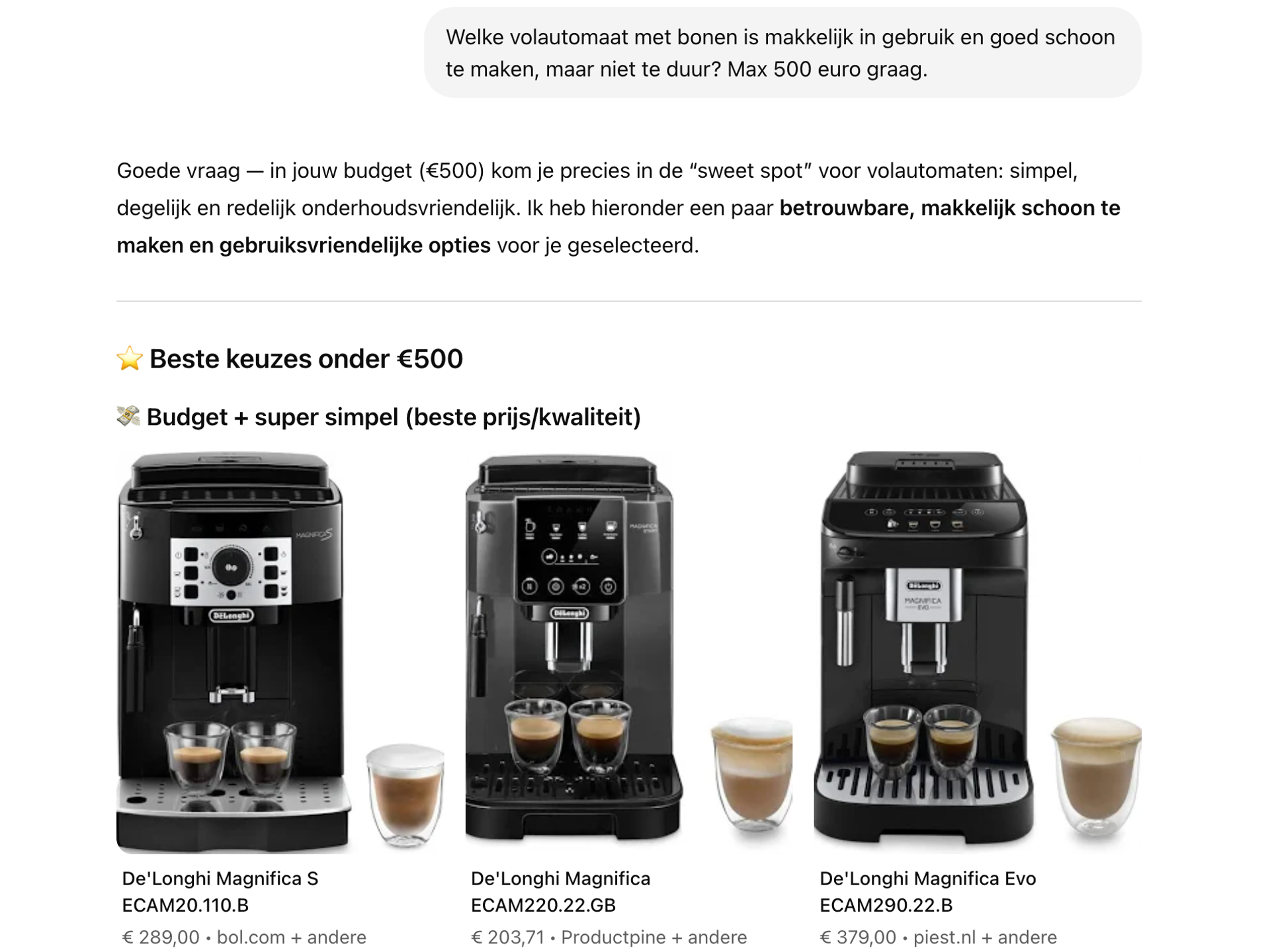
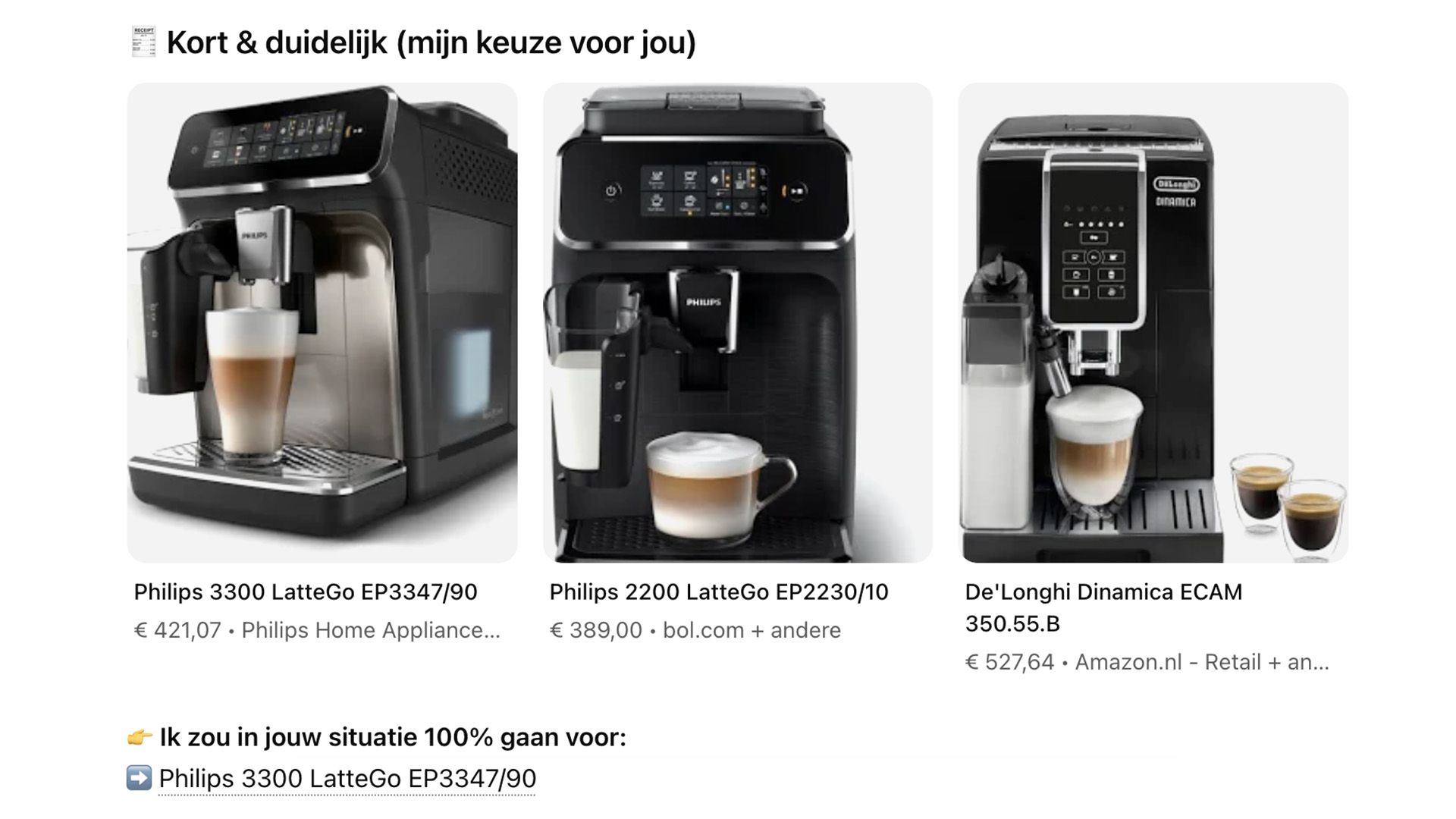
Before any deeper refinement, ChatGPT already turns a broad buying question into a first shortlist.
Yet no long intake conversation follows. A first shortlist appears quickly. A few logical options. Only then the refinement: do you mainly drink black or also milk, is it for one or two, do you want simplicity or a little more control?
That matters. It doesn't wait for the full picture. It picks a direction early and narrows from there.
For the buyer, it feels helpful. Less noise. Fewer tabs. No need to understand specs they've never come across before. For the market, the comparison is already narrowing before anyone opens a product page.
For the shopper it feels open. For the market it is selection.
To the buyer, it still feels like a conversation, open, with room for doubt and follow-up. But the answer is always smaller than the market it draws from. The assistant removes noise, surfaces a few options, and makes everything else disappear, not because those options are worse, but because any answer is smaller than the market it came from.
Only then come the finer differences: the price check, two models left to compare, which retailer feels right, whether the reviews hold up.
In the classic flow, you could still pick up traffic late. Someone landed on a category page, clicked around, read reviews, compared prices, switched between retailers.
With ChatGPT, that narrowing happens before any of that starts.
Miss that moment and you don't just lose a click. You were never in the comparison.
What we saw in simulations
To study that pattern, we picked a category where most buyers arrive without a fixed brief. Not because coffee machines are our focus, but because they're a useful lens for hesitation, trade-offs and the risk of getting it wrong.
We ran 298 buying conversations across two snapshots. In one, the model searched sparingly and late. In the other, it searched early and often. That difference is interesting, but it isn't the main finding.
The main finding is what stayed the same.
Brazen GEOlab: what kept coming back?
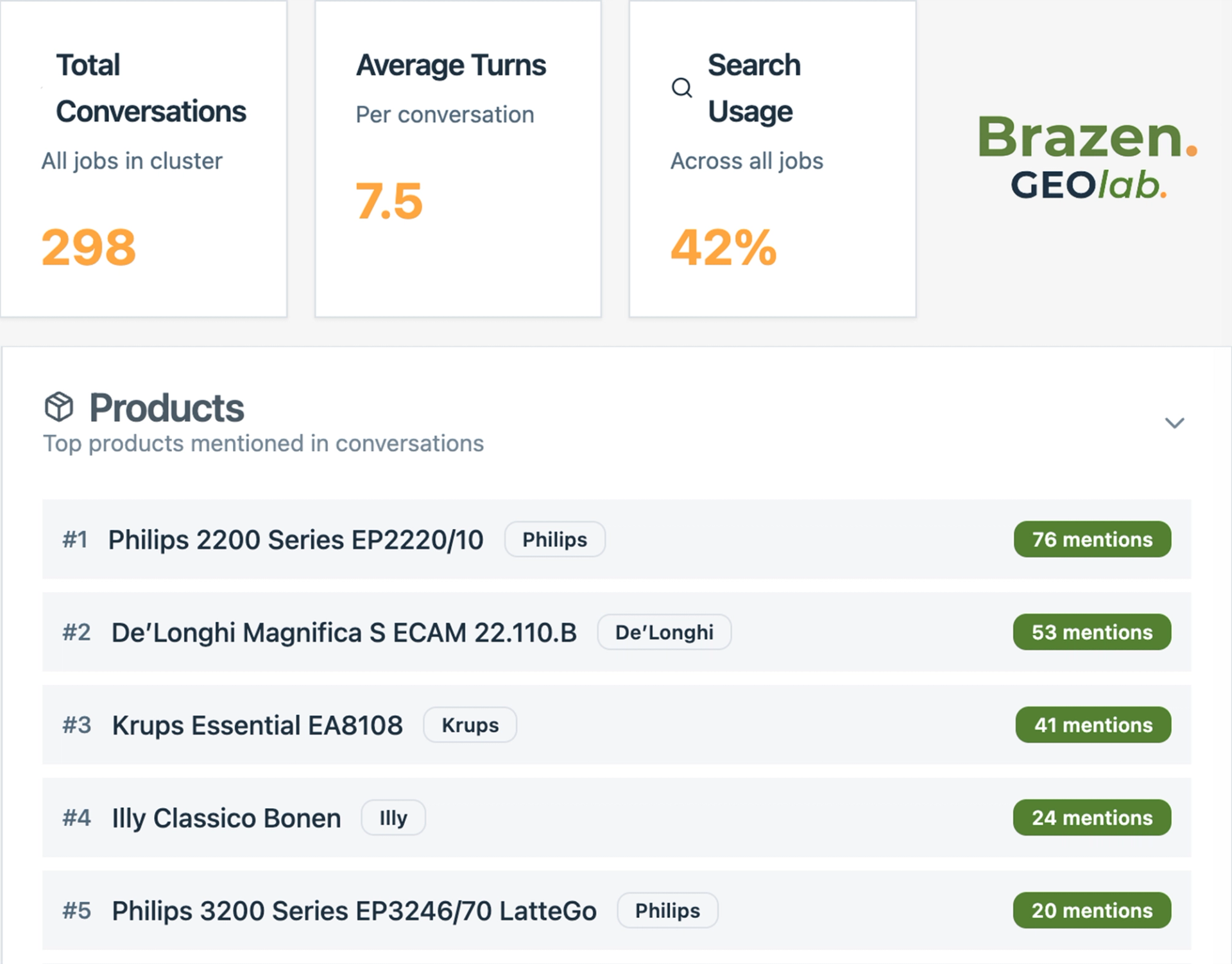
Across 298 simulated conversations, the same products and product families kept coming back.
Despite the different search patterns, the same product families kept showing up. Starting questions differed. Search behaviour shifted. The outcome didn't. The conversation felt open, but the market kept narrowing to the same small set.
That's what matters. Search patterns change. Interfaces evolve. The path to a decision can get richer or simpler. But when the shortlist forms early, the first real bottleneck isn't at the top of the funnel. It's at that first cut.
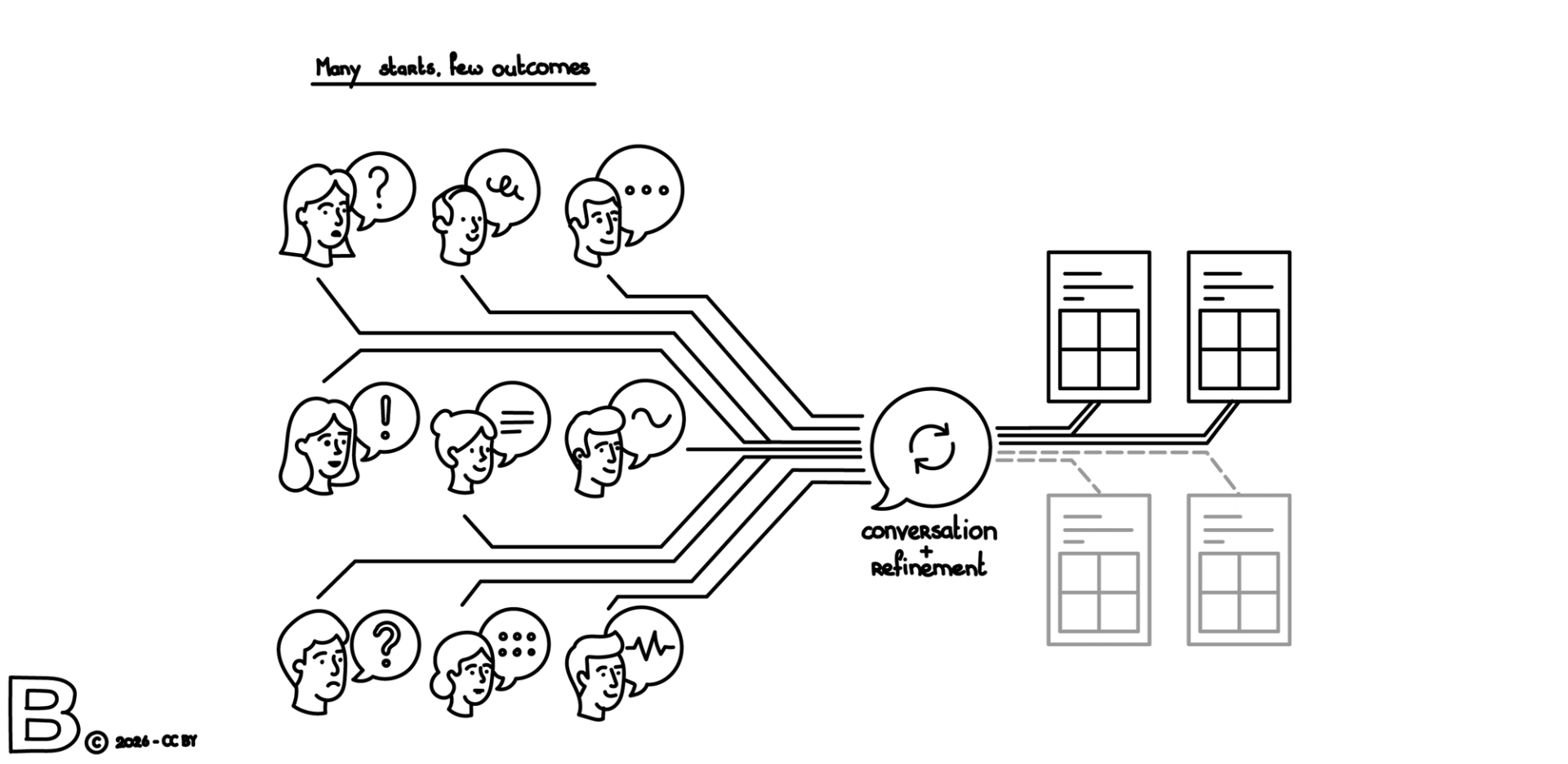
Many different starting points feel like open exploration, but in practice they often converge into a small set of recurring shortlists.
What this changes for online retailers
Many teams still treat AI as one more visibility point. Alongside SEO, marketplaces, Shopping and retail media. That is still too generous.
AI assistants don't just add visibility. They change what buyers see first, and that creates a gate earlier in the journey than most teams are watching for.
The questions that matter:
- which buyer questions pull our category into the answer
- which products keep coming back
- which specifications get weighted early
- which comparisons decide it
- what reassurance tips the final decision
Most e-commerce teams aren't set up to answer those questions yet.
The widest range doesn't automatically win. Nor the longest category page. Nor the most variants. More often, the winner is whoever feels like the logical choice at the right moment.
Where do you start?
The worst instinct is to go wide immediately. Every category, every brand, every prompt variant, every channel. That sounds thorough. It usually means a lot of effort and little clarity on where the selection actually falls.
Start where things stabilise first.
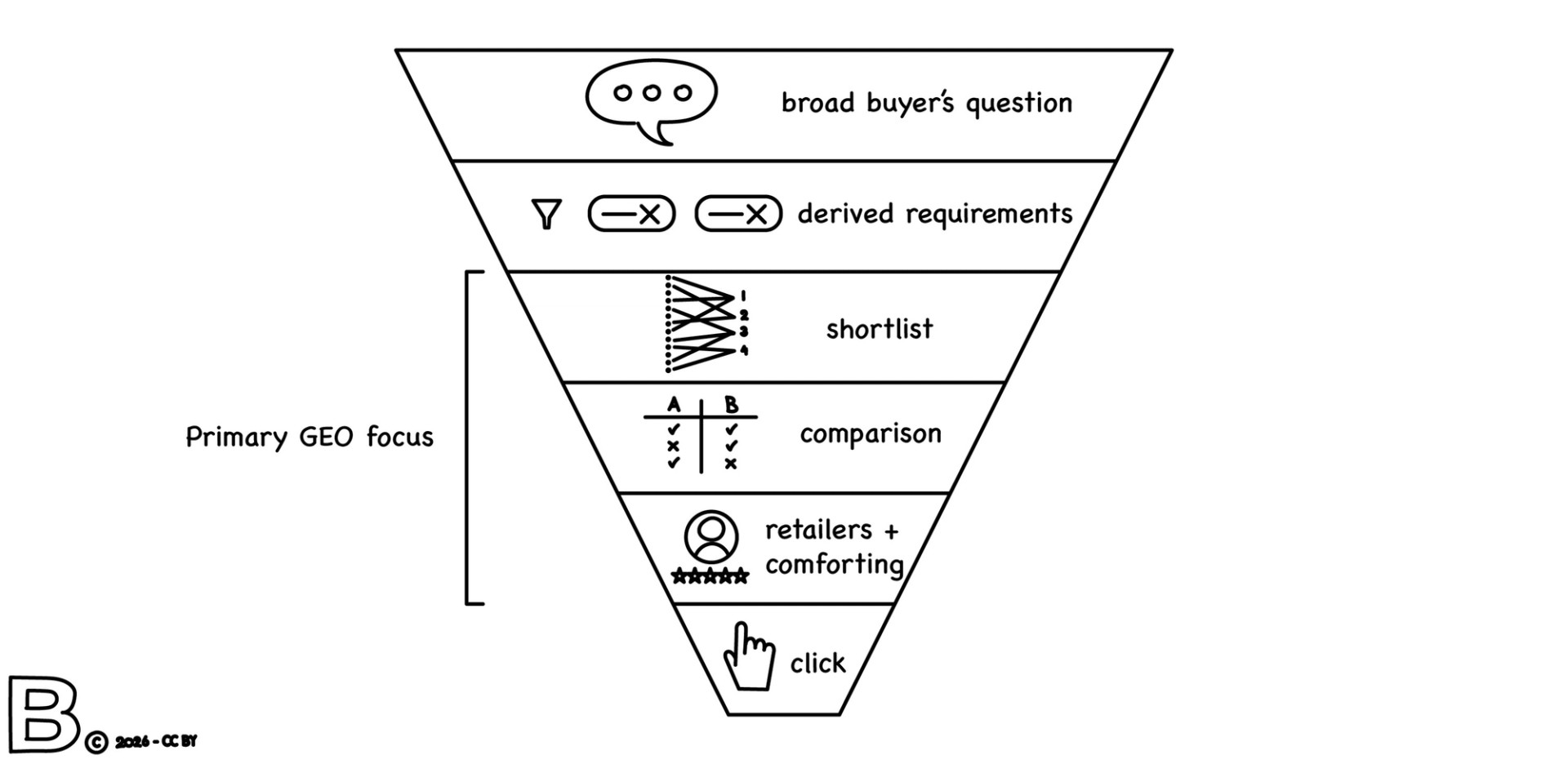
The first GEO priority often sits where the selection becomes stable, not where the question first begins.
Not your highest-traffic category. The one where buyers keep making the same trade-offs, asking similar questions, and needing the same reassurance. That's usually where the shortlist forms fastest.
For retailers and brands, that means asking:
- which products consistently show up in AI buying conversations
- which requirements travel with them
- which differences prove decisive
- which external sources and reviews shape the path
- which retailers feel credible enough for the click
Only after that does it make sense to work further up the funnel.
Because if this isn't working lower down, more visibility at the top just means more traffic arriving at someone else's shortlist.
The new e-commerce question
For years the central question was how to get found in a market with too much choice.
The new question is sharper.
Not how wide your range is, but whether your products are in the conversation before the real comparison starts.
AI assistants matter here. Not because of the hype, because they've changed how buying decisions begin.
First the shortlist decides who stays in view. Only then does someone win the click.
Also read:
AI & CommerceHow ChatGPT Builds Shortlists
ChatGPT builds shortlists in layers: question, source, product, store. This is how that selection takes shape in e-commerce buying journeys.
Read more →